Friday, January 1, 2016

legal - What permissions do I need to write a non-fiction book based on personal interviews?


I am writing a non-fiction book based on recorded interviews with several people. I have recorded verbal consent to be interviewed for the book from each person. One of the interviewees has since published his own book about the story he discussed with me. I have supplied written transcripts of the interviews to each person for review/clarification. I have not heard back from the one individual for almost a month and when I finally did make contact he was very abrupt, said he's been "very, very busy, and he was going to review it 'this week'." That was over a week ago and I have heard nothing.


Since I have recorded verbal permission and acknowledgement in his interview, can I legally move forward with his story as is or do I need to also have written permission? The other interviewees have signed a release and acknowledgment form, etc.


His story is a compelling one and would be a terrific inclusion for the book. I am confused about his reaction because when I told him I had completed the transcript he was eager to review it. He was very cooperative up to this point and at one time he asked if I would be interested in collaborating on his book. If he has changed his mind for whatever reason he has not indicated that to me verbally or in writing and his reaction is open to interpretation, which I prefer to avoid. A direct answer would be appreciated and I can move forward from there.


Thank you for any guidance you can provide.


fx - How is historical data for forex collected or computed?


I'm looking at four sources of forex data, as compiled in the question, What data sources are available online? And I think I must be misunderstanding something, perhaps something fundamental, but I'm not sure what. Given my ignorance, it's hard to pin down my confusion as a single question, so I'll express a few, in hopes someone can pick up on the source of my confusion and shed light.


  • The tick data from DukasCopy shows 5 columns: Time, Ask, Bid, AskVolume, and BidVolume. Am I correct to believe that this data shows no information about actual executions—only changes to the quotes? (Am I correct to believe that the AskVolume and BidVolume columns describe only the quantity offered at the Ask and Bid prices, respectively?)


  • The 1-second data from DukasCopy shows 6 columns: Time, Open, High, Low, Close, and Volume. Am I correct to believe that this data does show information about actual executions, i.e. Volume being the quantity traded in the given time period of 1 second?


  • OANDA only provides daily and weekly data, the forexforums.com links only provide 1-minute data (resembling DukasCopy's 1-second data), and GAIN Capital seems to provide tick data (resembling DukasCopy's tick data) without the bid and ask volumes. I have looked at many other sources as well, but can't seem to find tick data on trades, i.e. the time, price, and quantity at every trade. Am I looking for something that doesn't actually exist? If so, then why does it not exist?


  • I suspect it could have something to do with the non-centralized nature of the forex markets. But then, what exactly does this historical data, e.g. DukasCopy's, mean? Do these numbers only represent the quotes (tick data) and trades (1-second data) handled by DukasCopy (who I understand to be a broker)? Or, do they indeed come from some centralized aggregation of quotes and/or trades?


I have looked for explanations regarding the data on each of the four websites, but to no avail. I apologize for asking such a basic question; I'm very new to forex, and I'm surprised by how different it is from the the NYSE/NASDAQ markets, which I'm slightly more familiar with.


Answer


The fx market, contrary to most other asset classes is an almost entirely fragmented over-the-counter market, aside the very small number of fx futures that are trading at dismal liquidity levels. Therefore, you will not encounter a single serious liquidity provider that will take a stab at estimating total traded volume in any of the currency pairs. Having said that, there are some brokers that may show traded volume that crosses their own books, only. You cannot compare fx markets with any listed cash equity, futures, or options market. Why this is the case? Simple, historical reasons and traders and market participants really are against change unless of course it changes their own bottom lines. That is why many initiatives that were pushed by risk managers, back and middle offices died for lack of front office support, such as trade settlement at T+0. A decentralized market in fx works well enough for most players to see no need to change much about it. ECNs and aggregation frameworks saw the void and now provide quite a chunk of liquidity but in the end all they do is, well, aggregate. The actual liquidity still comes from various houses. In a sense it is funny if you really think about it because a 200 million block gets in the end passed from one hand to the other, while each hand retains a small chunk until it is split up sufficiently for the remaining hand to hold. So the same 200 million or part of it may pass the same brokers and order books several times before it is swallowed up by those the risk eventually ended up with.


To your bullets above (1-4):


1) you are right. And its only the quantity that the broker/ecn itself sees.


2) I cannot confirm that but I would logically assume that the volume refers to trades but again only at the broker. I have not come across many brokers that show trading volume or average traded prices or any other related trade data but that does not mean it does not exist. Some ECNs do show traded volume.


3) See 2, regarding trading data at each ecn or broker, it does exist but traditionally most market participants have not expressed much interest in such data because it is pretty meaningless. You can't meaningfully extrapolate to the market as a whole.


4) No centralized fx trading, hence no centralized aggregation unless you refer to ECNs that centralize/aggregate a chunk of total trading interest.


user behavior - Capturing UX using Factorial vignette studies


I am wondering if anyone has attempted to use Factorial vignette studies e.g., constant variable value vignettes or contrastive vignette techniques to explore UX for futuristic systems. I am looking at using such an approach to understand end user expectations and behaviors given certain scenarios described in the vignettes when using robots to perform tasks.


I am looking for any potential examples of vignettes being used in UX.


forms - how to indicate mandatory group in IOS -UPDATED


I have a form where fields are marked (*) to indicated they are required. But there is a strange use case where Level and Space have a dependency on each other such that either space or level or both space and level are required:


enter image description here


Obviously the sensible option would be to combine level and space into a single 'location' option, but due to time constraints the developer cannot. So we're stuck with this awkward situation where we have to make it clear on the interface either or both space and level are required.


question: how do I indicate to the user that at LEAST one of these fields is required?


layout - Should social sharing buttons be at the top or bottom of an article?


I can certainly see arguments for both sides of this one:


Buttons at the top: Easy to find, reliably positioned regardless of the article length. Extreme ease of sharing as you don't have to reach the end of the article to share.


Buttons at the bottom: Ensures your users most likely read or scanned to the bottom of the article rather than sharing the article immediately after reading the headline.


However I am wondering which is superior in terms of conversion. Do users share stories more if the sharing buttons are at the top of bottom of an article?


Answer


The most effective placement of social sharing buttons is the place, at which visitors make the decision to share and where it's the most prominent.


Naturally users will decide to share once they're done consuming the content. This means that the social sharing buttons should be located somewhere close to the bottom. However, content footers often contain a whole lot of meta information as well as links to "related" content and whatnot. All of that is competing for attention with the social sharing buttons. In addition, visitors won't know what sharing links are available until they scroll all the way to the end. Thus, it seems that they should be present at the top as well.


A less obvious advantage of top placement is that high sharing numbers serve as a form of social proof encouraging people to read & share the content when they're making up their minds.


AddThis (one of the leading social sharing toolkits, which I shamelessly promote because they're also from DC are) has these suggestions in their best practices for placement:


Do's


  • Keep AddThis near the top of the page

  • Place sharing near the content being shared


Dont's


  • Don't put sharing in the navigation

  • Avoid putting sharing in the footer

  • Avoid putting sharing below the fold


Their best practices also have an image with a sample layout and the instructions that read, Install AddThis before and/or after each post (see the link above).


Another set of placement recommendations from them suggests (italics added):


  • Keep your button near the top of the page: Avoid making your readers scroll to find your sharing button. It is okay to have the button at the top and bottom of the page, but users will find it easier at the top.

  • Watch out for navigation: be careful about placing the button too close to navigation, so users don't interact with it by accident.


Some developers think that multiple instances of nearly the same code shouldn't be repeated. The only position that satisfies both top & bottom placement is a fixed location. Most commonly, it is on the left side of the content ("in the empty space"). The problems with such a "solution" include visual imbalance, occasional JavaScript incompatibility/quirkiness, and no support for responsive design.


Other front-end devs might want to experiment with a horizontal sharing bar that appears once a user scrolls past a certain point but it still carries the disadvantages of the sidebar JavaScript module plus it's not going to be visible if everything fits above the fold.


Therefore, don't try being cute or gimmicky and put sharing tools both at the beginning and at the end of your content (just make sure they don't distort balance when everything is visible above the fold).


I'm looking for advice on character development


I'm currently working on a team based story with a lot of characters and am looking for ways to really make their personalities stand out from one another. When I'm writing out their character profiles I get to a certain point where, two male characters, for example, seem like the same character wearing another face. I give them different traits, and backgrounds but when I think about how they'll react to things, they seem like copies of one another. I thought perhaps I wasn't developing their personalities enough, but maybe it's another issue? Any advice will be greatly appreciated and I hope this edit clarifies things a bit.


inkscape - How does the P1 translation column horizontal shift (and other fields) work?


I really like Inkscape and I enjoy doing things in it, but even after using it for a while I have to say that many functions are obscure and counter intuitive (like the gradient editor).


My current problem is following: I'm trying to tile vertical line several times next to itself equidistantly. Like this, but all spaces equal:


stripes in mspaint, like bars


So I tried to create Tiled clones. After several google searched I finally (manually) discovered that this function is located in Edit -> Clone -> Create Tiled Clones.
Then I started to meddle with the function itself.


Tiled clones dialog


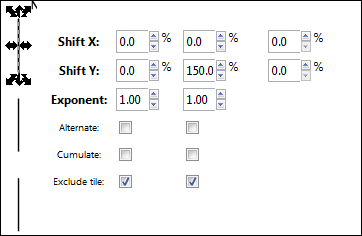
On the image you can see that even though I configured 200% horizontal spaces for every column (and the result should have 3 columns) the lines are all on one place. If I set n% vertical shift for every column, the result is following (it works):


tiled clones with vertical shift


I guess I misunderstood the GUI tooltips and field names. Could you explain what each settings on this tab means and how should I use them all to produce desired result?


Please do not omit the full explanation for other visitors.


Answer


What you are encountering is indeed a bug, which probably originates from the tiled-clones tool regarding lines to be of zero width. And as the distances used for horizontal tiling are based on the width of the object, nothing happens if you tile horizontally. If you tilt your line slightly or take a rectangle instead, the tool works as expected (and it’s easy to explore the meaning of the individual controls with this).


An alternative way to achieve your goal is the following:


  1. Create as many clones of your line as desired.


  2. Move one clone to the right (holding Ctrl) as far as you desire your right-most clone to be.


  3. Select all clones.


  4. Apply distribute centres equidistantly horizontally from the align and distribute tab.


technique - How credible is wikipedia?

I understand that this question relates more to wikipedia than it does writing but... If I was going to use wikipedia for a source for a res...