Friday, May 18, 2018

Illustrator Vector Graphics Appearing Pixellated


This has been puzzling me for a few days now, and I asked a graphic designer I knew before trying here and haven't been able to solve it yet. It's quite weird so please bear with me for a bit.


I am using Adobe Illustrator to create a logo, and I have something that can potentially work. I have used only the pen tool with strokes (no fill), but the issue is, when I view the logo at 100%, it looks pixellated! I know vectors should not even be able to appear pixellated, but they are. Here is the screenshot from AI, without exporting to anything:


image


That was just done using the snipping tool within Windows, and it's at 100% zoom.


I have anti-aliasing turned on from Edit > Preferences > General, and the document resolution is at 300 ppi (I get the same result with 72 ppi).


Could anyone help me with this?


If relevant: Using CS6, and have a 24 inch Dell U2412M at 1920x1200 resolution. I do have a 21.6" Samsung at 1680x1050 and I get the same result there as well. Let me know if you need any other settings, or if you would like the file, I'd be happy to provide it to be able to solve this problem.


creative writing - Should I focus on ideas which the market enjoys, or ideas which I enjoy?


Two approaches to writing:


  1. Writing about ideas that are currently 'hot' in the market (a bit like when the Hunger Games came out, many authors quickly released books which incorporated the same set of ideas)


  2. Writing about ideas that you would enjoy (and have enjoyed) reading about.


I don't have any statistics for this claim, but I'm fairly certain that many authors are influenced by the type of books they read, and are heavily influenced by the ideas which appear in the type of books they enjoy. I can't verify this (yet) but it's certainly true for me; I enjoy reading a specific subset of dystopian fiction (one where the protagonist suffers heavy losses), and the book which I'm planning to write features this key idea heavily.


It seems to me, that, ideas which appear in books are very similar to those that appear in the books that their authors enjoy reading.


My Question: Should I write books focusing on the market's interests, or my interests?


Answer


From your either-or phrasing, I understand that you're asking whether you should write something that appears "hot", but that you personally find utterly boring. How then do you propose to write such a thing? Do you see yourself sitting there, putting drivel on a page, fighting off boredom and disgust? What joy is there in such writing? What artistry? Do you respect yourself and that which you do, if what you write is of no interest to you? How can the reader find anything attractive in a work where you, the writer, find nothing? Are you treating your reader with respect, if you treat with contempt the story you give them?


The Hunger Games, and whatever was hot before the Hunger Games, and whatever will be hot after - when they emerged, they were all new, original, they were the books their writers would have wanted to read, found interesting to write, at their core were ideas the authors enjoyed mulling over and found something new to say about.
The works that came after, and seemed like copies, these too were written with love - by authors who wanted "more of the same", and failing to find it, wrote it. They were stories inspired by the first one, a response born of love.


You cannot tell a good story, unless you enjoy telling it. You've got to respect your work and your readers; if you find your story boring, you're not respecting either. Like a chef serving something he wouldn't eat himself. So write what you find interesting. If you put your truth into your story, there will be those who, like you, find it interesting.


So many volatility models. Any comparisons of them?


Are there any papers that make an explicit contrast/comparison of the following (or other) vol models in terms of the suitability for addressing some empirical problem?


  • Wavelet multiresolution volatility

  • EWMA

  • GARCH family

  • range volatility

  • derivative implied volatility, models from stochastic finance. SABR etc.


Answer


You may want to first broadly categorize volatility models before comparing between them within each class, it does not make sense to compare standard deviation models with an implied vol model.


I would broadly classify as follows:


  • Historical realized volatility: Those include standard deviation (sum of squared deviations), realized range volatility models, and essentially anything that is based on past price and return data. Such models strictly deal with past data points and do not bother to make any sort of prediction.


  • Implied volatility models: Those lead to volatility measures that are the other side of the coin of derivative prices, whereas the implied vol model functions as translation tool. Part of that categorization is the SABR model and essentially most all stochastic models that implement different sorts of Brownian Motion "drivers".


  • Volatility forecasting models generally utilize past data, contrary to implied volatility models, in order to make predictions about future volatility dynamics and levels. Most Garch volatility models fall under this category.


  • A sub-category deals with intra-day volatility models such as Pearson or Garman-Klass.


I understand that my answer does not compare each individual volatility model but I believe, or hope, it helps to broadly compare and classify different models.


Thursday, May 17, 2018

novel - How do I avoid a “mid-story info dump?”


I am revising the manuscript for a novel. About a third into the story, a major turning point occurs when the main character (through whom the reader follows the story) realizes that things are not at all how she perceived them to be, and that she has been duped by another character (let’s call him Ryan). For an entire chapter, she looks back at the events and pieces together Ryan’s moves and intentions.


The problem is, this feels too much like what I would call a “mid-story info dump.” We all have been told to avoid dumping out a truckload of back story at the start of a book before the actual action gets going. Here, in a similar fashion, I’m putting the main character’s actions on hold while she analyzes Ryan’s actions. There is little dialogue, just narration. It sounds a bit like the end of a Sherlock Holmes mystery: “And here is how I solved the crime.” Except in my case, it comes a third into the book, but it is a necessary step to launch off the remaining part of the story.


Is there a better way to handle this type of narration? Or should I simply not worry about it and count on the suspense created by the build-up to carry the reader forward? (If I’ve done my job correctly as a writer, the reader -- who has been duped just like the main character -- will be dying to find out what really happened).


Thoughts?


Answer


Short answer:


  1. Give hints along the book. Make the character notice stuff. It will make the "dump" shorter, even convert it into a short reference to scenes that happened.


  2. Find a way to imbue feelings or actions in the section.


More on that:


Include at least some action. Surely there is something that sets off this train of thought. Try and be as brief as possible with the explanations, and make the realization go hand in hand with events that happen.


The character could have a moment of clarity while, for instance, riding on a horse. Or a donkey. Or watching the scenery from a really beautiful vantage point. Then they could reflect on some things, then notice something else in the scenery, maybe even link it with what they are thinking, and carry on.


It also helps to place the feelings in the right place, so it feels as if the character is evolving through the insight gained... outrage, envy, anger, shame... they could be feeling any or many of those while they have that moment of noticing what happened.


Of course, structuring it like thoughts of the character helps give it pace... you could transmit racing thoughts, or slow-boiling, raging machinations. Either way, the character can make the info dump an interesting part of the book.


Do avoid anything like the description of the vices Dorian Gray had fallen to. Those pages are a painful read to anyone, no matter how awesome the rest of the book may be. The mistake in there is nothing happens. You get the raw information; no emotion, no action. This is a perfect "how not to".


Wednesday, May 16, 2018

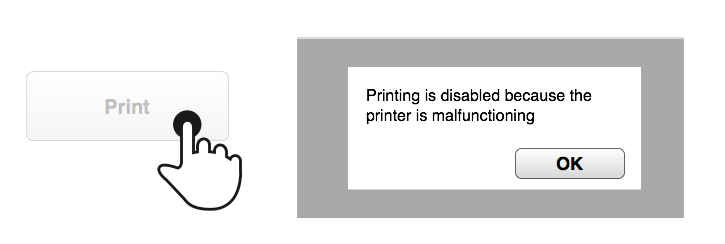
Should the user be able to press disabled buttons on a touch screen?


I'm designing a touchscreen app and there are certain scenarios when the server cannot be reached, a printer is disabled, etc. that will disable a button (like the print button).


My question is: if the button is disabled, should the user be able to select it?


For instance, would it be beneficiary to trigger an overlay with more information as to why the button is disabled when the user selected the disabled button?


A wireframe of the behaviour described above, where tapping a disabled


creative writing - How to make side-characters look competent next to the chosen one?


I'm writing a storyline for a game where the forces of evil have humanity cornered. Truly everything seems lost, that is, until our main character decides to step in. Let's call him Bob. The Chosen.


Bob is extremely strong and has a special ability that's seemingly designed to counter the evil monsters. As a result he defeats enemy after enemy effortlessly, becoming humanity's last hope. He is stationed in a small village on the front lines where he gets to know the villagers and protects them from the monster assaults. Word spreads about his deeds and a second character is introduced: Sir Dave the Brave, the Virtuous, Vigilant Paragon of Hope, Knighted by the King, Slayer of Monsters.


Dave is currently the kingdom's greatest swordsman and leads the royal knights against the forces of evil. He's beloved by the citizens because of how many of them he has saved. He and his army set up camp in the village on order and from that point on Dave serves as the face of the kingdom.


The problem is that Dave is only human - he does not have the unique superpowers Chosen like Bob have. He is still very strong, but very strong for a human. After he set up camp the player isn't going to look at him anymore unless he decides to raise his affection level with Dave. Dave only has a single chance to prove himself as the competent knight he is. But I'm afraid that it doesn't matter how many mobs I let him defeat, the player will invariably compare those feats to his own. I can't have him be strong enough to defeat the bosses, the player is supposed to do that on his own.


When he tags along to scout for one of the bosses and he gets swatted aside it doesn't really give the wanted reaction of "Goodness, that monster is strong!", but rather something of an "Haha, silly Dave got defeated again." His competence as a swordsman has become an informed attribute. Even if I let him defeat a few monsters on his own he still feels weak because the great Bob kills those in his free time to farm xp.


I don't want Dave to be strong strong, but I do want the player to acknowledge him. Is there a way to make Dave look like a competent knight without affecting his or Bob's power level?


Answer


You need to think about your protagonists weaknesses – now!


If your protagonist is simply above and beyond everything and everybody else it will get really, really boring. Your character needs some form of development, some things to strive for. Dave has to be better in something, and that something is not necessarily bashing monster's heads in.


Think about other aspects. Investigating a murder for example. Maybe your character is just bad at deducting stuff and needs to look up to Dave for being good at this stuff. Or talking to the locals. Maybe he is just not that good with people. Organizing people – a great leader can make an inspiring speech every day to send search parties so that he can help at multiple places at the same time. Not by himself, but by organizing everything. Dave has connections to the higher-ups. Dave has experience that tell him about monsters' weaknesses and strengths, when to fight and when to flee, when a dungeon will collapse and bury every character, no matter how strong ... Dave knows his way around town quickly in case you need to follow something. Or maybe he is good with medicine and can heal people?


Whatever it is, he didn't get to where is just by being good with a sword. Fighting is not all that there is to life. And brute strength is not everything that counts in the world, not even in a videogame world that is trying to make the player feel powerful.

covariance - What are the units of the variance of returns?


I am a little confused about the units of the variance of returns. One way to compute that would be to look at the units of returns-


$$r=\frac{1}{\Delta t}\ln\frac{P(t+\Delta t)}{P(t)}=\text{Dimension }(\text{time})^{-1}$$


$$\text{Cov}(r_i,r_j)=E[(r_i-\bar{r}_i)(r_j-\bar{r}_j)]=\text{Dimension }(\text{time})^{-2}$$


But the above seems incorrect. For starters variance scales with time, i.e. annual variance is 12 times the monthly variance (assuming iid returns). Also stochastic calculus tells us that $\sigma$ or standard deviation scales with $(\text{time})^{-1/2}$. How do I reconcile that with the above?


Answer


There is nothing incorrect with your formulas, so let's look at the units when you annualize the volatility.


As an example, assume you have 252 daily return data. Their dimension is $(time)^{-1}$ and their variance is given in $(time)^{-2}$ (as you already stated). You may look at Chris Taylor's answer here on the underlying assumptions, why one can annualize volatility as $$\sigma_{\rm annual} = \sigma_{\rm daily} \times \sqrt{252}.$$


In fact, the scaling factor $\sqrt{252}$ is expressed with no unit. This arrises from the central limit theorem:


When using log-returns, the annualized return is calculated as $R_{year} = r_1 + r_2 + \cdots + r_n$ with $n=252$ daily log-return data. This sum of daily return data converges towards a normal distribution with parameters $N\left( n \mu ,n\sigma_{daily} \right)$, where $\mu$ is the mean of daily returns. This scaling with the factor $n$ is done without any unit. So on both sides of the above formula you have the unit $(time)^{-1}$ for the standard deviation of returns and the daily one scaled dimensionless by $\sqrt{252}$.


In a statistical meaning, the factor $n$ is just the number of data points you observe, although they represent single points in time in the context of financial calculus.


technique - How credible is wikipedia?

I understand that this question relates more to wikipedia than it does writing but... If I was going to use wikipedia for a source for a res...