Wednesday, May 22, 2019

fiction - How do I write numbers in dialogue?


My proofreader recently revealed to me the following, which I was wholly unaware of:


...when a number/code/serial or whatever is said in dialogue, you write the whole thing out...


I had written the designation of a robot as Unit M55/987.3, and he said I would need to sound it out:


...“Unit Em-fifty-five slash nine hundred eighty-seven-point-three has been terminated.”...


Is this true? If it is true, can I still 'ignore' it as one of those grammatical liberties authors sometimes take (in the same class as using fragments)?


Answer


In fiction, there's no rule for this, only differing styles and opinions. However, some editors seem to like using the Chicago Manual of Style's alternative rule for this.


9.3 An alternative rule--zero through nine. Many publications, including those in scientific or journalistic contexts, follow the simple rule of spelling out only single-digit numbers and using numerals for all others [...]


It goes on to reference the exceptions to this. (9.3 is an alternative to the more strict rule 9.2 that requires spelling out all numerals from zero through one hundred.)


Exceptions to these include spelling out round numbers. For example: "seven hundred", "one thousand", "forty-seven thousand", etc. There are also other rules for money, ordinal numbers, decimals, percentages, etc, but these are overkill for fiction.


The number you indicate in your question is more like a serial number. I can't find anything for that, but personally I'd use the abbreviated rule for numerals in general, using numerals and letters and not spelling them out. Unless the character's name were something short like the robots in Star Wars, where (for example) R2-D2 becomes "Artoo" for short.

Tuesday, May 21, 2019

What would be the benefits of knowing JavaScript as a UI/UX designer?


I'm a UI/UX designer and work for a start-up creating a web-based application serving a specific target audience. Although not required for my job, I'm trying to teach myself JavaScript and would like some of the JS experts out there to tell me how knowing JS could help a UX designer and in what respect. Also, I'm wondering how challenging it would be to get familiar with it given that I have some basic knowledge in jQuery and ActionScript3.


usability - How to display search results for different versions of an item?


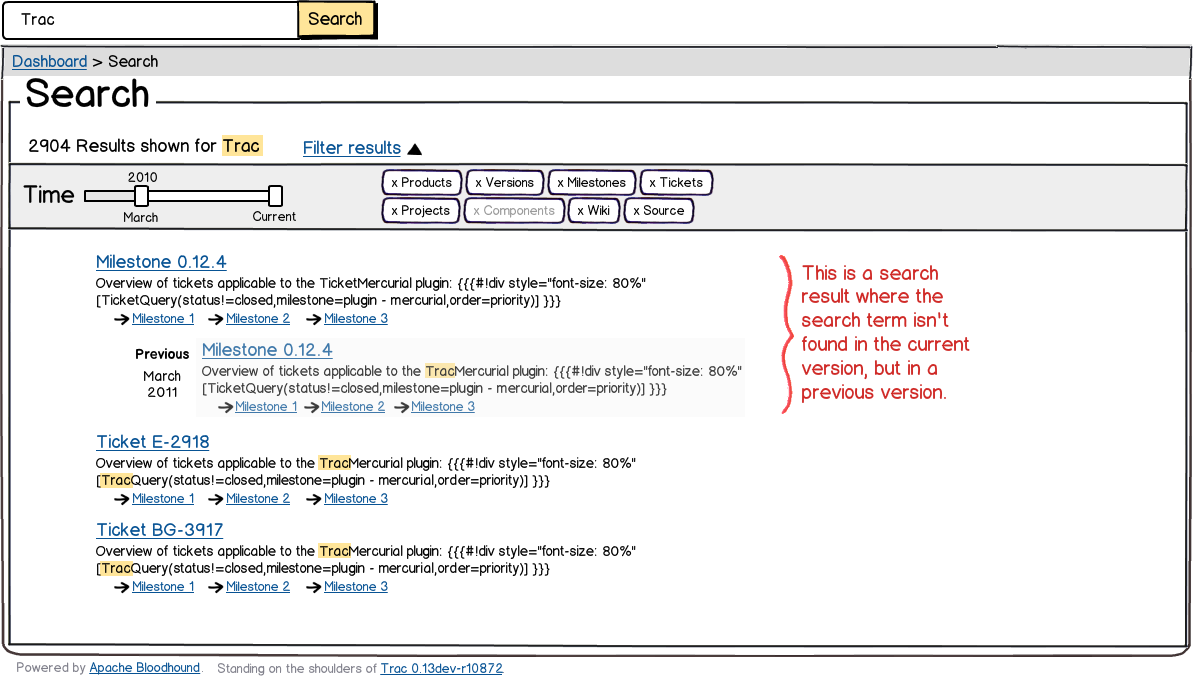
The Apache Bloodhound defect tracker I'm working on may show historic results in search in a future version. That means even after an item has been altered (like the description text of a Ticket), when searching for the previous content this would be shown in the search results in some way.


As a practical example: Someone has edited the description of an item and removed a word (Trac) by which I actually remembered the Ticket. When I later search for the word Trac, I'd expect to find it in the results, even if it isn't in the current description anymore.


So my question is: How should you display search results for different versions of something?


Below is a mockup of my first stab at what that may look like.


mockup


download bmml source – Wireframes created with Balsamiq Mockups


Answer


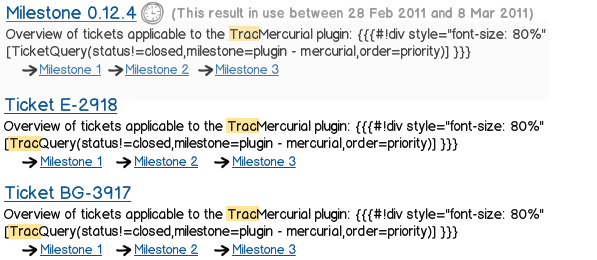
I'm not sure you need to complicate the results with an in-line revision history (even if it's only showing now and then), but you can indicate that the search result is something that was only in use during a certain time period so that you can determine its relevance.


Since only the older version shows the search term, I think that's the only version you need to display.


If the revision history is something that is useful and not already accessible by following the search result anyway, then you can include a link in the text that allows the user to examine the versions of the text in more detail - just not in-lined with the other results.


Anything that is current of course needs no further markup.


I like the fact that you used a fainter text colour to show the older result - as if the text has aged in some way.


I'm not sure how your Time slider works (assume it's a time-range filter) but I would urge you to consider the usefulness of this version searching functionality as over time, the amount of historical revisions could grow to be quite large and the older search results could overwhelm the more relevant up-to-date results - not to mention performance issues maybe? Consider at least making it optional in some way.


mockup


download bmml source – Wireframes created with Balsamiq Mockups


layers - Automation of repetitive tasks in Photoshop?


Is there a way to automate some highly repetitive tasks in Photoshop?


Example 1


I have a folder of images.


  1. For each of them, and I want to import each as its own layer

  2. I'd like them to be resized such that each is x% larger than the previous (or some other formula)

  3. I'd like them positioned within the canvase such that they form a sequence


Example 2


I have a single layer with an image; and I'd like to make y duplicates of that layer, where


  1. Each duplicated layer is z% smaller than the previous layer

  2. Each duplicated layer is w% rotated from the previous layer


To be able to achieve these, something more complex than a macro would be required. A scripting language, perhaps, or some form of advance macro?


Is it possible to achieve his in Photoshop?


If not, is it possible in any other image manipulation program (e.g. GIMP)?


Answer


Yes, photoshop has something called actions. To use actions, go to Window -> Actions and create a new action. Then, do ONLY want you want you action to so (resize, duplicate, etc.) Once you have completed what you want your action to do, stop recording your action. Now, whenever you want, you can recall that action, and it will do the same thing, to whatever image you open in photoshop.


(I use CS5, in Windows 7)


In addition to that you can write your own scripts.


Looking for illustrator script to swap all objects with another


I have a map with small circles for over 200 cities. I need to change all of the circles into map pins. Is there a way to do this? I think it's a script maybe.


I know how to select all objects of the same appearance and give them a new graphic style but that will only let me change the color, stroke, etc. not replace with a new shape.


From short fiction to a novel


I write short stories.


However, the more I research, the more I find that people prefer novels over short stories (irrespective of the quality of the work).


This may be partly due to the pricing structure (e.g. Amazon Kindle) where 99 cents can buy a novel (It begs the question as to why would anyone want to pay 99 cents for a short story then).


I want to turn some of my short stories into novels. I am wondering what are some approaches other writers use to extend the length of their work, while at the same time, maintaining the quality.


(I guess this applies from the start when a writer has an idea and then expands it. In my case, the idea is now a story i.e. short story, which I want to take further without losing quality.)


Answer


I share your opinion. I also think readers prefer novels over shorties but not necessarily because of the price. In my case, I don't buy short stories because I always end with that -- it was too short -- felling.


Being a good or a bad shortie, I always end up with that feeling that I could had more. Those rare times I bought a short story, were because it was sold inside a book with a collection of short stories but, even so, I would rather have one of those shorties developed into a novel.


But, back to your question, the easiest and more interesting way to change a short into a novel is to use subplots.


The short story will have only the main plot line, most of the times, because of space. It's all a matter of having the unexploited parallel stories of your short appended to it.


If the short is about a police man that finds out a bomb in a post office and manage to disarm it, saving everybody inside, you could write a parallel plot about the recently fired mailman, who wrongly lost his job when he found out his boss was stealing money from the company, and decided to avenge himself by blowing everything up.


You could also write about the unrequited love the policeman had for the girl who work at the post office, and made him to go there a lot detecting something was not wrong... And even that the girl didn't returned the love because some mob guy blackmail her for some reason.


The main plot line is almost the same as the one in the shortie -- a police man that finds out a bomb in a post office and manage to disarm it, saving everybody inside -- but the subplots will change it into a novel and allow you to develop everything into a more complex web.


Monday, May 20, 2019

Layers with different directional drop shadows in Photoshop


I am wondering how to have 2 different directional drop shadows in the one file with Photoshop. e.g. 2 different type layers — one has a drop shadow at 90 degrees, the other at -45 degrees.


Currently it seems Photoshop only lets me have 1 universal direction for the whole file, which I find really pointless.


I know how to apply different drop shadows and merge down layers to achieve the same thing, but its tedious and not exactly streamlined for making future changes to that layer.


How is this achieved?


Answer


When you are setting the drop shadow effect on an layer, uncheck the "Use Global Light" checkbox.


enter image description here


technique - How credible is wikipedia?

I understand that this question relates more to wikipedia than it does writing but... If I was going to use wikipedia for a source for a res...