Sunday, February 3, 2019

usability - Heuristic approaches for users' evaluation of UX


A heuristic evaluation typically employs three main approaches;


  1. Provide evaluators with a set of tasks to be carried out

  2. Provide system goal’s and let evaluators develop their own tasks

  3. Let evaluators assess dialogue elements


I understand that choosing the right approach depends on time constraints and the maturity of the system. So for instance if the system is a functioning product then the first approach shall be used, the second approach is for early stages, alpha, beta... But i don't understand the third approach can somebody please explain?


Answer


As the SitePoint article, from which I believe this question is derived states:


Ask evaluators to go through the interface a number of times and examine and assess the efficacy of those elements of your Website that contribute to a dialogue with your site visitors.


If you're looking for when this approach would be used over the other two, I'd say probably when the design and copy is thought to be complete but maybe the functionality isn't quite there.


Edit: For example, UX.SE's intended is for users to ask and answer questions about UX. If you look at the top navigation, the sidebar at the right, the main content area or the footer, all the visible items (read, elements) contribute to that and help get questions answered.


Saturday, February 2, 2019

fiction - Writing a Super Intelligent AI


Something I have been thinking about recently is how to write a character who is an artificial intelligence and not have him feel human. Specifically an AI who is designed to think faster and better than a human. In my current book, I have an AI who acts humans, but that is part of how he was made. I tried writing a book with a super intelligent AI before (a book that will hopefully never be read by anyone besides me), but the character felt too human. Part of the problem is a human can't fully comprehend how a super intelligent AI would think. Does anyone have any advice for writing an AI that doesn't feel human?


Answer


I will disagree with others. I am a professor involved in AI, and the easiest way for you to think about a super-AI is to understand what Intelligence IS.


Predictive power. Intelligence is the ability to discern patterns (in behavior, in sound, visually, by touch, even by smell) and use those patterns to predict other facts or high probabilities: What will happen next, what will be said next, what people are feeling (or doing mentally, like lying), or any other properties: how hard or fast it is, how heavy. Where it will be, if it is a danger.


High intelligence is the ability to see such patterns and use them to accomplish a goal, be it staying alive, keeping somebody else alive, or making money. Or just recognizing what is going on in your life.


High intelligence does not require the machine be human or have emotions, you can add those separately if you like. But a highly intelligent machine would likely not be socially inept at all (contrary to the silly example of Data on Star Trek). They would not be confused by humor, and should be rather good at it. Certainly, Data that is supposed to think about a hundred times faster than people, should have recognized jokes immediately as a common pattern of human interaction, and should have been able to laugh convincingly: The idea that he cannot recognize the common pattern of actual human laughing, and emulate it without error, is dumb and unscientific writing. He could listen *to himself practicing a laugh, and note the differences, and correct until he sounded sincere: If we can tell the difference, he can tell the difference faster, that is the nature of super intelligence, or it isn't super.


Your super-AI will be a super Sherlock; never missing the slightest clue, always several steps ahead of everybody else.


But it is not infallible. There are things no amount of intelligence will reveal: The outcome of the next coin flip. The traffic jam on the Franklin Bridge, due to an overturned truck. Whether Roger will fall for the planned ruse. There are things there is just no way to know from the data it has so far, so it cannot be certain of them, and that puts a limit on how far into the future the AI can predict things. It has limitations.


AI is the ability to give answers, to the questions of others or its own questions. It is the ability to anticipate the future, and the further into the future it can predict with success better than random chance, the more intelligent it is. "Better thinking" is more accurate thinking (perhaps with less data), faster thinking is self-explanatory, but the reason it makes a difference is it lets the AI run through more simulations of influencing the future so it can more often choose the best of those; the best of a thousand ideas of what to do next is highly likely to be better than the best of three ideas of what to do next. So the AI does the best thing more often than humans, because it had more ideas (also based on having more patterns it recognized and might be able to exploit).


Added to address commentary:


Although you can certainly give your AI "goals", they are not a necessary component of "Intelligence". In our real life AI, goals are assigned by humans; like "here are the symptoms and genome of this child, identify the disease and devise a treatment."


Intelligence is devoid of emotions. It is a scientific oracle that, based on clues in the present, can identify what is most likely to happen in the future (or like Sherlock, what most likely happened in the past to lead to the current state of affairs). That does not automatically make the Intelligence moral or immoral, good or evil. It does not even grant a sense of survival, it does not fear or want death, or entertainment, or love or power. It does not get bored, that is an emotion. It has no goals, that would be wanting something to come to pass, and "want" is an emotion. Your coffee pot doesn't want anything, it does what it is told and then will wait to be told again, an eternity without boredom if given no further command.


If you wish to have your AI informed by emotions and therefore have its own goals, desires, plans and agenda, that is separate from the intelligence aspect, and how it works IRL for humans. Our emotions use the more recently developed frontal cortex as a slave, and can hijack it and override it (which is why people do things in a rage or fright or protective panic that they would never do if they were thinking; this is called amygdala hijack). Our frontal cortex (the Natural Intelligence part) solves problems, projects consequences, simulates "what will happen if" scenarios, puzzles out what must have happened, why others did what they did, etc. Those products of intelligence can then inform the emotions: The sight of the collapsed trap means you finally caught an animal in your spike pit and you and your family will eat meat tonight -> elation and excitement. You know you failed your final exam -> dread and worry about having to retake the class, anger at the professor or others that led to this problem, etc.


We are emotional beings, so it is hard to realize that just knowing something does not imply an emotion must be generated. But that is the case, an AI can diagnose a patient with terminal cancer and know they will be dead in sixty days and report that as a fact no different than knowing the length of the Tallahassee Bridge. Like a Google that can figure things out instead of just looking them up.


Added (after 85 votes, sorry) to address commentary moved to chat:


Some additional clarifications:


Input, output and sensors and processor speed do not mattter. I am talking only about Intelligence in isolation. Something can be intelligent (and creative) with very little actual data; consider Stephen Hawking and other quantum physicists and string theorists; they work with equations and rules that could fit in, say, two dozen large textbooks covering the math and physics classes they took. That amount of data (images and everything) could fit on a single modern thumb drive, and can be pondered endlessly (and is) to produce an endless stream of new insights and ideas (and it does). Stephen Hawking did that for decades with very limited and slow channels for his input and output (hearing, sight / reading, extremely slow "speech" for his output). Super intelligence does not require super senses or (like Hawking) any ability to take physical action beyond communicating its conclusions and evidence, and though it must rely on processing, our definition should not rely on its internal processing being particularly faster than that of a human.


Q: Doesn't an AI doing what we ask constitute an emotion, wanting to please us? That is not an emotion, it is something the AI is constructed to do. My hammer head is not hard because it wants to hit things without being damaged, it was just made that way through a series of forced chemical reactions. Some person wanted it to turn out that way, but the object itself does not want anything. Our AI can use its intelligence to diagnose diseases because it was made to do that, and it does require real intelligence to do that, it does not require desires or emotions. AI can beat the world champions in technical results just because it is better at interpreting the data and situations than they are.


AI is limited to X, Y, Z (Markov processes, it cannot process emotions without emotions, etc). No. There is no reason an AI cannot simulate, using a model, anything a human could do. Imagine a highly intelligent police detective. She can have an extensive mental model of a serial killer that kidnaps, rapes, tortures and kills children. She can use that mental model to process patterns of his behavior and gain insight into his motivations and his compulsions in order to capture him. She does not have to feel what he feels, not in the slightest, to understand what he feels. A physicist doesn't have to BE an atom or particle to understand patterns and develop a model of them. Doctors do not have to BE autistic to model and understand autism. An AI doesn't have to BE a person or have emotions in order to understand how emotions work or drive people to take action (or not take action).


ending - How to motivate yourself to finish something?


Far too many stories of mine have gone unfinished simply because I lost motivation to keep writing (and it doesn't help that I manage to convince myself each project will be my magnum opus). How can I keep myself with a project or keep myself from dropping it until I see it come to fruition?


Laying out checkboxes in forms


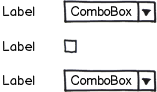
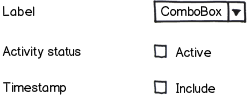
I have some pretty large forms mostly consisting of text fields and dropdowns. However, there are also checkboxes scattered here and there. I'm trying to figure out the best way to lay them out. Here's the problem:


If I align my label to the right and the control itself to the left, then my checkboxes are not in the same column as all my other controls


mockup


download bmml source – Wireframes created with Balsamiq Mockups


If I align the control to the right, then its label isn't aligned with the rest of the controls and I'm afraid it may be missed.


mockup


download bmml source


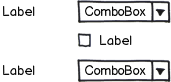
The solution seems to be to separate the label from the control. What bothers me in this solution is that the target region of the checkbox is small and even if I make it larger, users may think they need to "snipe" into the checkbox itself.


mockup


download bmml source


To solve this I've been playing around providing both a general label and a specific one for the control, but in most cases it feels very unnatural and forced. Instead of saying for example "Include timestamp" I'm forced to do things like "Timestamp: Include", which sounds terrible.


mockup


download bmml source


It seems to me that the best option is 3, but maybe I'm missing something. Are there any guidelines or any better solutions for this?


Answer


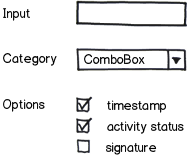
I would try to group as many checkboxes as possible under a single label:


mockup


download bmml source – Wireframes created with Balsamiq Mockups


Friday, February 1, 2019

Does anyone know a good pixel font 7px tall?


I'm looking for a pixel font which I'll use later on to convert/use on an lcd type of display and the maximum height is 7px.


I've started by checking out dafont's bitmap fonts, but it takes quite a while to test all of them. I've played with a few and I'm surprised to see only a few work well when set to a small size (7px max height). I was hoping someone might have had a chance to play with more and recommend them.


In the meantime I've started designing mine, just a few characters for a quick test/demo, but I wouldn't want to reinvent the wheel when it's not needed.


Answer


Joe Gillespie did some great micro screen font work under the MiniFonts moniker.
These are still available via MyFonts.


Silkscreen is a related design by Jason Kottke.


design principles - Designers response in an adverse situation during the presentation of a project


Hypothetical situation:


It is a presentation of a corporate image for a male sports club. The meeting includes the client, the marketing director, the purchasing manager, the client's wife, and two important employees.


The name of the club refers to a corpulent, vigorous and strong animal. The logo represents the head of that animal, seen from the front, which gives a feeling of strength, impetus, resistance and decision.


logo


Behind there is a circular frame, very representative of the main object of many sporting events.


Indirectly simulates the support of hunting heads, that reaffirms the masculinity of the corporate image and it works like a strong support for the pictogram.


As a total symbol resembles a heraldic shield, referring to the club's tradition and history.


The designer presents each element of the corporate image.


Everything is going well, until one of the listeners says that the logo remains to something different for him.


ov


How should the designer react?


selling ux - The coding monkey dilemma


This is a quotation from an interview with a practitioner with a technical background and role:


Developers are all smart people; they don't enjoy their work if somebody tells them this is what you need to do and this is how you're going to do it. Nobody wants to feel like a coding monkey.


I call this 'the coding monkey dilemma'. I am sure many of you who work with UX have experienced similar situations in which the role of a UX person, interaction designer or similar is somewhat considered a 'threat' to job satisfaction of developers. I agree that introducing new expertise such as UX means division of responsibilities and losing power in some areas for other roles.


My question is what approaches (processes, tools, methods, etc.) do you use in your work as a UX expert, interaction designer, or similar to overcome the 'coding monkey dilemma'?


I would also like to read more about this if you know of any references.


Answer


Code monkeys are a symptom of a lousy design and development process which emphasizes direction/management versus dialog/collaboration.


There are many names for this kind of process (waterfall, linear, directive, etc) but at the heart of it, the code monkey syndrome comes out of a design/development model where developers are seen as resources to be directed rather than partners in a process:


directive vs collaborative model


The directive approach is weak for many well-documented reasons.


  • Developers feel unempowered, uninvolved, and underappreciated in the process.

  • The process stifles upward feedback, or slows it down.

  • The lack of feedback and iterative mechanisms makes it slow and inefficient ...and much more


Collaborative development


Turning code monkeys into collaborators enter image description here


Collaborative development models generally use concepts of shared ownership, conversations, and iterative development to accomplish several goals:


  • Avoid code monkey syndrome by giving developers (and other stakeholders) ownership and an active role in decision making.

  • Improve 2-way communication by breaking down walls/silos/functional barriers which can slow down open co-operation.

  • Speed up development by providing an experimental/prototyping/iterative rather than linear process, resulting in faster failure/error detection and faster product evolution. ...and other benefits


Under a collaborative development model, the UX professional becomes a facilitator, not a director of product activity.


  • By promoting collaborative design process, guided ideation, facilitated conversations, and shared ownership of the product development process, the UX professional maximizes the contribution of team participants instead of directing team resources to do a job.


There are many tools and frameworks to reference here for facilitating collaborative development:


  • Frameworks such as Agile, Spiral, Lean, and others provide overall structure and guidance for collaborative product development.


  • Behavioral models such as Flow, Hyperfocus, Hierarchy of needs, N-Ach and others help provide psychological models for motivating developers and designers in a team environment.


  • Team process methods such as design interviews, storyboarding, structured ideation, and others provide collaborative guidelines for accomplishing specific tasks inside the production workflow.


Hopefully these terms/concepts will provide a launching point for your further research.


technique - How credible is wikipedia?

I understand that this question relates more to wikipedia than it does writing but... If I was going to use wikipedia for a source for a res...