Monday, May 20, 2019

website design - What objective arguments can be provided to prove that a colour scheme for an app is bad?


We have a design for an app developed by an external agency and our business people seem to be happy with it. But it’s really terrible - the colours are too bright, the text is difficult to read and so on.


How can we persuade our business that it needs to be changed? We can’t just say “We don’t like it, it sucks.” We need to have valid points against this colour scheme.


I understand that colours are subjective. But are there any objective metrics that can show the difference between bad and good app colour scheme?


What sites can I use to crowdsource my writing project?


I have a writing project I'd like to crowdsource. I imagine opening the project definition to an open call, and awarding the work to the most creative writer / thinker based on a sample of their work or on the complete deliverable.


What sites exist that provide a good platform for such a project?


adobe photoshop - Best practices around creating LARGE poster image 24X36


I need to create a large image (for print) at 24X36 inches. It is a seating chart poster for a wedding. What settings in Photoshop would I set for an image this size (DPI, etc.)? I would need it to remain sharp when printing so suggesting some Export options would be great too.


Answer


It will be inkjet printed, so 300 ppi will give you plenty of quality. If the file size on disk gets excessive, 150 ppi would also be fine, but for a seating chart that's unlikely to be an issue.


Export to ("Save As...") PDF using "High Quality Print" as the preset, and you'll be fine for printing at your local FedEx/Kinko, etc., or on a desktop printer if you have one that will print 24" paper. Uncheck "Preserve Photoshop Editing Capabilities" to keep the file size down (but don't save over your PSD, just in case!).


If you're taking it to a digital print shop, ask them if they prefer the PDF in RGB or CMYK. If they say CMYK, use "PDF/X-1a:2001" as your PDF export preset. Otherwise use "High Quality Print."


gui design - How can I highlight errors when bright red is the main color of the brand?


I'm working on a mobile website for a client whose main brand color is red. The website header and headings are all red. CTA buttons are red too. How can I effectively separate errors (mostly in form processes) from the content?


Answer


Just because your brand color is red doesn't make the use of red for errors obsolete, it's just a matter of extent.


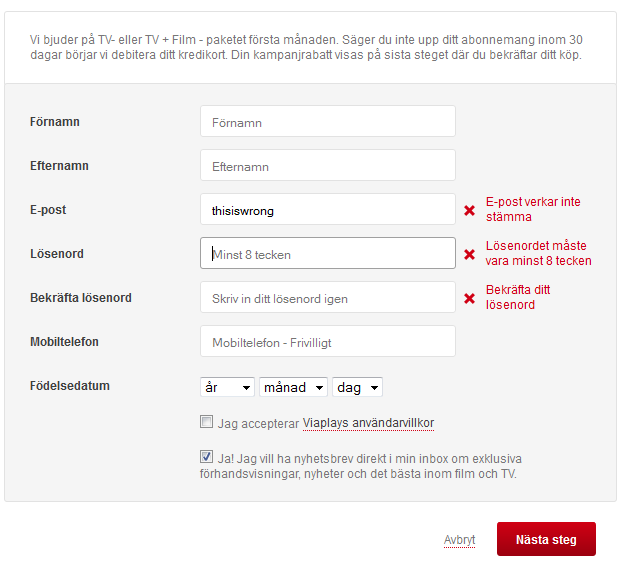
Take the Viaplay signup form for example:


enter image description here


Viaplay has red as their main accent color, which is used throughout the website for actions buttons, icons, header, graphic elements etc.. however, in the form they do tone down the use. They don't let the background be red, or having the labels for the input red either for that matter. So in the context the red error messages still stands out.


To put it short, it's a matter of context even within a context. When it comes to user input, eg. a signup form, simply avoid extensive use of red and the typical in-line error messages will still pop against the background.


writers block - The psychology of starting a piece of writing


I have a problem when it comes to writing (blog posts, stories and novels). It might just be me, but maybe other people have experienced it too? When I come to start writing, my ideas before I sit down seem wonderful. But just recently, as soon as I see that blank page, it seems like all my enthusiasm drains out of me and I feel like what I'm going to write is utter rubbish - trite and derivative. Consequently I can't start writing.


I know that these states of mind are built on passing, ephemeral thoughts, but they are pervasive and fill me with alternating enthusiasm and dread.


The irony is - I love to write. I am eager to get to my computer to start on my latest idea. But the blank page stops me dead. It seems to glare at me malevolently. Does anyone else experience this, and if so, have they found a way around it?


Sunday, May 19, 2019

publishing - What are the advantages and disadvantages of digital rights management for self-published authors?


DRM (digital rights management) is being used in just about every electronic format, including files used in electronic readers. My question is whether this is a good thing or a bad thing for writers, or does it really matter?


Since an author with a "traditional" publishing contract really has no control, this is really targetted more towards self-published authors who are also responsible for doing their own promotion and marketing.


I would like to know if not using DRM can result in your work being pirated or will it be a non-issue? If people do end up giving away copies, does DRM have the potential to lead to others buying the work out of guilt or possibly buying one of your other books? From a marketing perspective, does this make good business sense?


Answer


This is basically a question of marketing strategy.


The major pro of DRM is that it helps avoid pirating; the major con is that it limits accessibility and portability, and can annoy readers and users.


So it seems to me that the primary consideration should be: "Is pirating going to cost me so much, that I'm better off risking limiting and annoying users?".


For most independent, self-publishing authors, I think publicity is the biggest concern. If you're popular enough that pirated copies are really costing you, that probably means you're doing astoundingly well. Whereas finding readers is tough; you don't want to turn anybody off because of incompatible readers or annoying registration processes - they might easily skip your book entirely. So by default, I'd lean towards DRM free. But here are some additional considerations:


  • For publishers, DRM probably makes a lot more sense than it does for a single author. If your own personal titles are being pirated, you might not be losing a lot; if you've got hundreds of titles being pirated, that might be more of a dent.

  • You may have certain idealogical preferences - about pirating, or copyright, or current DRM practices - which you'd like to reflect by your choice of whether or not to use DRM.

  • You may want to use a publishing platform which does or does not utilize DRM; if you don't have strong preferences on DRM, this issue may be secondary to publishing on the best platform you can.


fiction - Would it be cheating to change the main character's "name" partway through the story?


I'm writing a story written in third-person limited, and the main character has no real name. They simply go by the nickname they're given by the people they hang around at the time, resulting in many different nicknames depending on where they are. Then, they're finally given a normal name that doesn't sound like a title of some sort.


So, what I was thinking of doing was: in the first handful of chapters, third person refers to them as one of their old nicknames, and continues doing so even after they are given a real name in their new environs. Then, at some point, as their character grows attached to the people who call them by that name (and by extension, the name itself), the third person refers to them as their new nickname.


This is meant to mark a point in the story where the character no longer sees themselves as a tool or symbol as they used to in the past, instead seeing themselves as a person as the people surrounding them now see them as. Also, it's meant to mark a point when they'd become comfortable with their new environs, whether they'd like to admit it or not.


Would this seem too jarring for the reader, though? All characters would still refer to them as their new name (outside of flashbacks), and rare changes in PoV before the character's change would still refer to them by their new name.


Answer


Interesting question. Changing a character's name is definitely jarring to the reader (at least it has been to me). The best suggestion I've found to deal with that is to create tension about the name. If the reader spends half the story wondering what the true name is and building up to that, they'll want the name to be revealed, and it won't be jarring at all. However, you are dealing with a slightly different problem.


You say:


Then, they're finally given a normal name [...]


This leads me to conclude that this isn't so much a birth name, as a name selected by people who care about this character. That makes how you refer to the character very important and symbolic, as you seem to have figured out.


I think the same principle as above might apply here, if you change it a bit. Introduce tension surrounding the name. Will the character accept it? If the reader wants the character to adopt this new name, then they will cheer when he starts using it, rather than be surprised or confused. Be sure to keep increasing the tension for awhile; the more the reader anticipates the name change, the better.


I think no matter what you do, referring to this character by their new name in narration will be jarring. I think you can lessen that effect by building tension as I've suggested, and also include a scene or internal monologue where the character actually decides to use his name now. Have him basically say or think, 'never again will I be called [nicknmae]. From now on, I am [name].'


The last thing I would suggest is not to surprise the reader. Don't save using that name for the first time for the next chapter. Once the character says the above, call them that name in narration. Or better yet, acknowledge both names in narration and basically reiterate what the character just said. So for example:


[Nickname] was [nickname] no longer. He was [name]. And [name] would never return to who he used to be.


In those three lines I restate what the character just said, and then use the name in narration myself, just to drill it home. THEN you can end the chapter (because that seems like a good point for a chapter to end to me - totally optional though). The point here is that the first time you use the new name in narration, should not be the opening of a new chapter. I think that could be really jarring, especially if the reader paused between chapters for any good length of time.


Best of luck in your writing!


technique - How credible is wikipedia?

I understand that this question relates more to wikipedia than it does writing but... If I was going to use wikipedia for a source for a res...