Saturday, June 20, 2015

accessibility - What are the most common UIs/Components? What are their Strengths/Weaknesses? How to improve?


Hm, I am fininding myself wishing that we had communitywiki


After seeing this question: What is the most common user interface in the world? I thought it would be educational to not limit the discussion by trying to single out the most common, but instead discuss the many common interfaces that we (read: mankind) interact with daily, and how they can be improved.


So, what are the most common UIs/UI components? What are their strengths and weaknesses? How can they be improved?


For example:


Combo Boxes


Combo boxes are abundant through out the web and in desktop software.


Pros: Good for allowing a user to have a list of choices while requiring minimal space when not in use.


Problem: Becomes unwieldy and hard for a user if the list of choices is too long.


Potential Solution: Autocomplete Combo Boxes, using text matching on typed user input to narrow the list of possible choices and enable easier selection.


Obviously I didn't invent the Autocomplete combobox; note that answers don't have to be improvements you invented.


user research - What's the term for modeling detailed customer behavior in service/UX design?


Let's say I'm designing a service experience for a restaurant app.


For a typical restaurant, you have an owner, a manager, an executive chef, line cooks, waiters, and a bar manager.


Only the waiters will use the application.


I am trying to find literature on the practice of developing a behavioral model for each person in this system (owner all the way to bar manager). The model includes application-related stuff (e.g. how they will use the app) but also includes a lot of other non-app behaviors like who influences the purchase decision, what the owner's perception of the app is even if she doesn't ever use it, what their business priorities are irrespective of the app, etc.


The question: What is the term used to describe this practice of interviewing and analyzing people involved in and around an app for the purposes of building a detailed behavioral model?


What I've tried


  • User/UX research is usually oriented at understanding user behavior with respect to an app, whereas I'm focused on really understanding the user's business needs without regard to the app.


  • This is different from psychographic segmentation, which I've used for high-level segmentation of users. Here we are looking at specific roles (e.g. an owner will always be concerned over the profitability of the restaurant)


  • It seems to be different from UX/marketing personas because I'm focused on understanding the behavior and incentives of concrete roles rather than abstract examples (e.g. "Pam is a soccer mom...") used for personas.


  • It seems close to a voice of customer analysis, but voice of customer is traditionally focused on understanding the customer's needs and wants rather than building a behavioral model of how they operate within the business.


I'm asking for the term because that will at least point me down the right path to finding tools to help build this behavioral model.


thanks!


Answer


You are probably looking at a combination of technics/methodologies to get to a behavorial model:


1. Ethnographic field study (Based on interviewing and observation in situ) two aspects to consider here:


A-Descriptions of the scene: Describe the physical aspects of the work environment, including the layout of workstations, desk space and clutter, collaboration and conversation areas.


B-key events and incidents: What happened, and who did what? What is your impression of these incidents, and what are team members’ thoughts in regard to and interpretations of these events? How do they feel about them?


2. Contextual enquiry ( based on interviewing and observation in situ but more structured and task focused.


Both options are part of Contextual Design methodology but an Ethnographic field study is more comprehensive than a Contextual Enquiry. So I would suggest using a full field study first before fine-tuninng using a contextual enquiry.


For more details about different approaches and when to use them :


enter image description here


3. Ethnomethodology (Focused on the "procedural" aspect in day to day interactions and is more oriented towards Computer-supported cooperative work)


Hope that helps


How to write dialogue for someone who is intelligent but barely speaks the language?


I have a character who is a refugee from another country. She comes to the protagonist, and they have a couple of scenes together, viewed from the protagonist.


I read about how important it is to make dialogue convey information about the character, to prevent adverb overdose (e.g. "Blabla, he said wisely."). Intelligence I would indicate with a broader vocabulary. But how do I do that when someone is intelligent but should not have that vocabulary? If I write everything using described gestures, broken grammar and disconnected words - as it would realistically be - that person will quickly sound like an idiot.


Answer


Insight. Or, if you're so smart --- Prove It!


I think you misunderstand intelligent people, and I wouldn't rely on vocabulary to indicate it in the first place.


I am a professor in a university, intelligent by conventional standards, but in my work and in my speech I do not use a complex vocabulary, because I consider it far more important to be understood by the people I am speaking to than to impress them.


If I am speaking to students, they are basically high school graduates, so my vocabulary (without slang of my generation or theirs) is set for their level. If I am talking to colleagues I will use all the specialized terminology and references of our fields, but my vocabulary is tuned to what I expect that person to understand, for efficiency's sake. Note this is not a high bar: Many professors struggle with common English outside their fields. They represent the real life example of what you are talking about; highly intelligent with difficulty communicating.


The solution to your problem is to show the reader the consequences of intelligence. Don't try to tell them. Have your foreign speaker use their intelligence to get their point across. Draw a diagram. Solve an equation: here is an example from math.


Frustrated, she rises and walks to the whiteboard. she points at an integral amongst his dense equations, and held up a marker with eyebrows raised. He'd been staring at this problem all week. He picked up his phone, zoomed and snapped the board, then gestured at her to proceed.


She rubbed out a foot of space after the integral and wrote a transformation of it, then looked at him.
Stokes? That would help but you can't do it without proving compact support on a smooth manifold! He had neither! He tried to think of a sign for compact, and held two cupped hands together to make a ball.
She nodded once, and pointed higher on the board to a previous equation, pointed at her head, then cupped her hands as he did, then rubbed one flat hand against the other.
Compact and smooth? He stared at it; and shook his head. How do you sign corners? He touched fingertips with fingers at right angles, then did it again moving his hands around, many corners. She nodded, erased more of the board and began writing ... dividing his domain. He watched for sixty seconds and his throat caught. She was right, the corners were countable, the support would be compact and by Whitney's generalization ... Stokes would hold!
Why hadn't he seen that? He felt a strange combination of thrill with a flush of embarrassment: His problem was solved, and he was an idiot. If it was even still his problem. When she finished, he nodded, lips tight. She turned to erase the rest of his equations after Stokes, and began writing, quickly and without pause, to finish the rest of his manifold transformation in two long lines. She stood back to examine it, then capped the marker and put it back in the tray, turning back to him.
He stood, and quietly applauded, then pointed at her.
"Sue Jen?"
She pointed at herself. "Suzhien. Sue. Zhee. En. Suzhien."
He held out a hand. "Suzhien. Richard."
"Reeshard?" she said, pointing at him. He nodded. Close enough. He lowered his hand.

She pointed at the board. "Suzhien." She made a lifting motion with her hand, "Reeshard."
Then she pointed at Richard. "Reeshard." Again she made a lifting motion; "Suzhien."
With hesitation, she put her hands together flat, in prayer, and pushed them toward him.
Ah, not lift. Help. Please help.
"Yes," he said, and nodded. "Help. Richard will help Suzhien."


Of course, in whatever way your character is intelligent, you must invent a scene where that intelligence can shine without language; not always easy. I chose math because it is an easy choice, an arena in which the "language" of symbols and notation is truly universal throughout the modern world.


One might say the same thing about chemistry, physics, mechanical engineering, and perhaps other scientific fields like biology. It would be less true in fields dependent on language or culture that your highly intelligent person has not learned. She can't be an expert on Shakespeare if she has never read him and can't understand what the actors are saying.


The hallmark of high intelligence is NOT, as is commonly portrayed in nerd fiction, an inability to express yourself, or an inability to understand what the less intelligent and less articulate are saying. Nor is it opaque language others have difficulty understanding! I have spent near a lifetime in colleges, and in my experience "elevated" language is pretty much always a shield for banal ideas. When restated simply such ideas are cliché, pedestrian, or just plain laughable.


The hallmark of high intelligence is, like Sherlock, seeing clues others overlook, and thinking quickly to solve problems using those clues. Not just math problems or physics problems or computer problems. All problems. Including how to deal with and work around a handicap like not knowing the language.


Truly intelligent people are smart enough to make their complex ideas understandable in terms that others can understand. If your character is a genius with the vocabulary and language comprehension of a two-year old, find ways for her to show her genius by taking action to solve problems in creative ways that nobody around her can. The benefit of her skill will make others do the work necessary to understand her.


Friday, June 19, 2015

client relations - Is it okay to attempt to retract pro bono work?


I am a member of a non-profit organization that has used a logo that was designed pro bono by one of our members for several years. Very recently, this designer has had a falling out with some of the organization's members that was purely personal and had nothing to do with the work. He is now asking us to remove his logo from all of our materials and not to use it in the future.


Are we obliged to follow his request? It seems to me that he donated his time and expertise (for which we're very grateful) at a time when he had no expectation of eventually wanting us to stop using it. He still uses the logo and designs on his personal portfolio site, including a picture of an active member wearing a shirt with the logo on it. I think of this as a parallel: If I make a cash donation to an organization, I can't later ask for a refund, nor can I expect both a refund and a tax deduction.


interaction design - What should the default view of a map be when you don't know a user's location?


I'm working on a project for a company with thousands of global locations. For the 'store locator' the client has asked what is the default view of the map when it's impossible to get GEO IP. I'm kind of stumped. My gut reaction was to show the map zoomed out to global view, but then what would I show in the location list on the left? (There are thousands of locations.)


What would you do in this case?


Here's example: http://buff.ly/1eqJMbB


I am trying not to paginate the list on the left.


Thursday, June 18, 2015

progress bar - Should a progressbar go both ways?


I'm developing a long-running algorithm and want to give my users an idea of what is the current state of the calculation. I thought of adding a progress bar indicating the percentage of all the calculations already done.


My problem is that the total number of calculations to perform can not be estimated beforehand. I'm somehow discovering a tree and cannot know how vast the tree is without actually exploring it.


With regards to the progress bar it means that the progress bar can sometimes go backward.


For example, let's say that my tree has 10 root elements at the beginning, I perform calculations on the first element so I'm at 1/10 = 10% completion but discover 10 new others elements at the same time, leading to a 1/20 = 5% completion.


Is the progress bar still useful is that case ? I want to avoid to only report X out of Y elements processed.


Is there a better way to report the status of the number of processed elements when the number of elements to process can grow ?


Answer


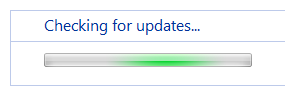
If it is possible to traverse the entire tree before beginning processing, I would display an indeterminate progress bar while you discover the branches and then switch to a traditional progress bar once you know the maximum value.


indeterminate progress bar windows


If you cannot identify the total size of the tree before processing, then a progress bar may not be the best option. A progress bar indicates progress towards a known and unchanging maximum. If you don't know the maximum, you can't define the parameters of the progress bar.


In that case, maybe a textual description that is updated in real time would work better. Something like:


Discovered Items: 115


Processed Items: 32


I would definitely not recommend having the progress bar move backwards. This tells the viewer that progress is proceeding backwards or being undone, which is not the case.


Wednesday, June 17, 2015

selection - Is there a pattern for cycling or toggling through time periods?


I'm looking for a pattern for toggling between different periods of time. Currently I've prototyped an example which is a single button that, when tapped, will cycle through 3 time periods: by month, by quarter and by week. Cycling through the time periods adjusts a goal number that is set by the user (ie 100/month, 300/quarter, 25/week). I'm having trouble finding other examples of a pattern similar to what I've mocked up.


We've done a little but of user testing with this example, and they seem to be confused at first but immediately understand the functionality after tapping it. Is there something that I can do to add more affordance to this interaction, whether it's a different button/toggle style, an added icon, etc? Or is there a completely different, better pattern altogether? Screenshots or links to established patterns are greatly appreciated!


technique - How credible is wikipedia?

I understand that this question relates more to wikipedia than it does writing but... If I was going to use wikipedia for a source for a res...